Tuesday, 24 February 2015

Hot Springs and Soccer Playing Alpacas!

Feb 20, 2015

Up early. Raúl, José and Raúl's 17 year old daughter Mariana came along for the ride to Chivay via Coporaque where we made a pitstop for Coca tea. Along the road we stopped a number of times to check out sheep, vicuña, llamas and alpacas!

We met Abel, a 12 year old who was herding 40 sheep and he came up the hill to meet us when José called him over. He was very shy but told us he was in Grade 3, that he lived about a 20 minute walk away. He owns one pair of shoes - sandals made of tire treads and his little toes were gnarley and filthy black.The kids that live out here in no man's land are usually malnutritioned and some don't go to school. Those that do can go up to Grade 6 nearby but after that they would have to go to a bigger town for further schooling and sometimes it is just not affordable. We gave him some candies, a banana, some leftover chicken and a boiled egg that we had, some pens for school and a flashlight. He was most excited about the food.

Next we pulled over at the side of the road where two kids David, 9 and his 15 year old brother were herding llamas and alpacas and had them all coralled in a small circular rock wall. David said that he used to walk 3 hours each way to school but they moved to be closer to it. The house is in very rough shape.

Did you know that alpacas play soccer? This was fun. We grabbed an old deflated ball the boys had and tossed it in with the amimals, which of course drew out the soccer players in the bunch. A few laughs. Alpacas only have bottom teeth so Rainer was comparing me to them. He's such a funny guy. By the way, for those who missed it on ESPN, the soccer score was Alpacas 1, Bloess 0. They also had better footwork, were quicker on the ball and could dangle with their finesse moves. We left them with Canada t-shirts and flashlights and they were pretty happy (the kids, not the alpacas).

We rolled into Chivay and had a nice buffet lunch down a back street where I took another shot of two kids bottle- feeding a baby alpaca water. Because we took his photo he asked for a tip, to cover the cost of milk for his pet. Guess they prefer milk to water.

In Chivay we visited some hot springs and spent a few hours surrounded by mountains soaking up the great heat. It was getting cooler here so the heat was welcomed.

We made a pitstop back at the hotel, dried off a tad and headed for a folkloric dinner show which was fun, especially since Rainer got dragged up for two dances while I escaped withe only one, to the tune of El Condor Pasa, better known in Canada by the lyrics, "I'd rather be a hammer than a nail". Oddly enough they play this at the Peruvian changing of the guard in Lima as welll! Rainer 'performed' a dance called malaria where he was poisoned by his wife with an orange and when she thinks he is dead she starts flogging him (in the crotch of all places). It's pretty funny.

Back to the hotel to reorg for tomorrow's fun! We could hear Carnaval partiers late into the night in the town square.


Monday, 23 February 2015

Ariquipe (and Lima - Como se llama?)

Feb 19, 2015

An early start as José told us about the tiered farming by pre Inca peoples. The lands are shamrock green and flush with crops, primarily potatoes, corn, alfalfa, fava beans, some mustard and quinoa. Cattle, sheep, lambs, llamas and some alpacas, (on most menus), graze. This land is surrounded by volcanos, some snow-topped and smoking.

It is incredible to imagine how much time and effort went into initial planning, bringing rocks up mountains to make restraining walls, followed by back-breaking efforts to plant, cultivate, harvest and actually get the produce from point A to point B without means of transportation, or machinery, save for burros. We're talking 4,000 years of planning, building, etc., pre Inca. They still walk miles down dusty roads in all kinds of weather with bundles strapped to their backs in brightly woven shawls. In one case we saw a man lugging two large jugs, one in each hand who was miles from the closest village. We asked what he was carrying and were told it was milk. 

Years ago, the men used to work in the gold and silver mines and women took over the primary farming and apparently still do. Though most men no longer work the mines, women are the principle farmers, caregivers and educators. And the men have the drinking problem...

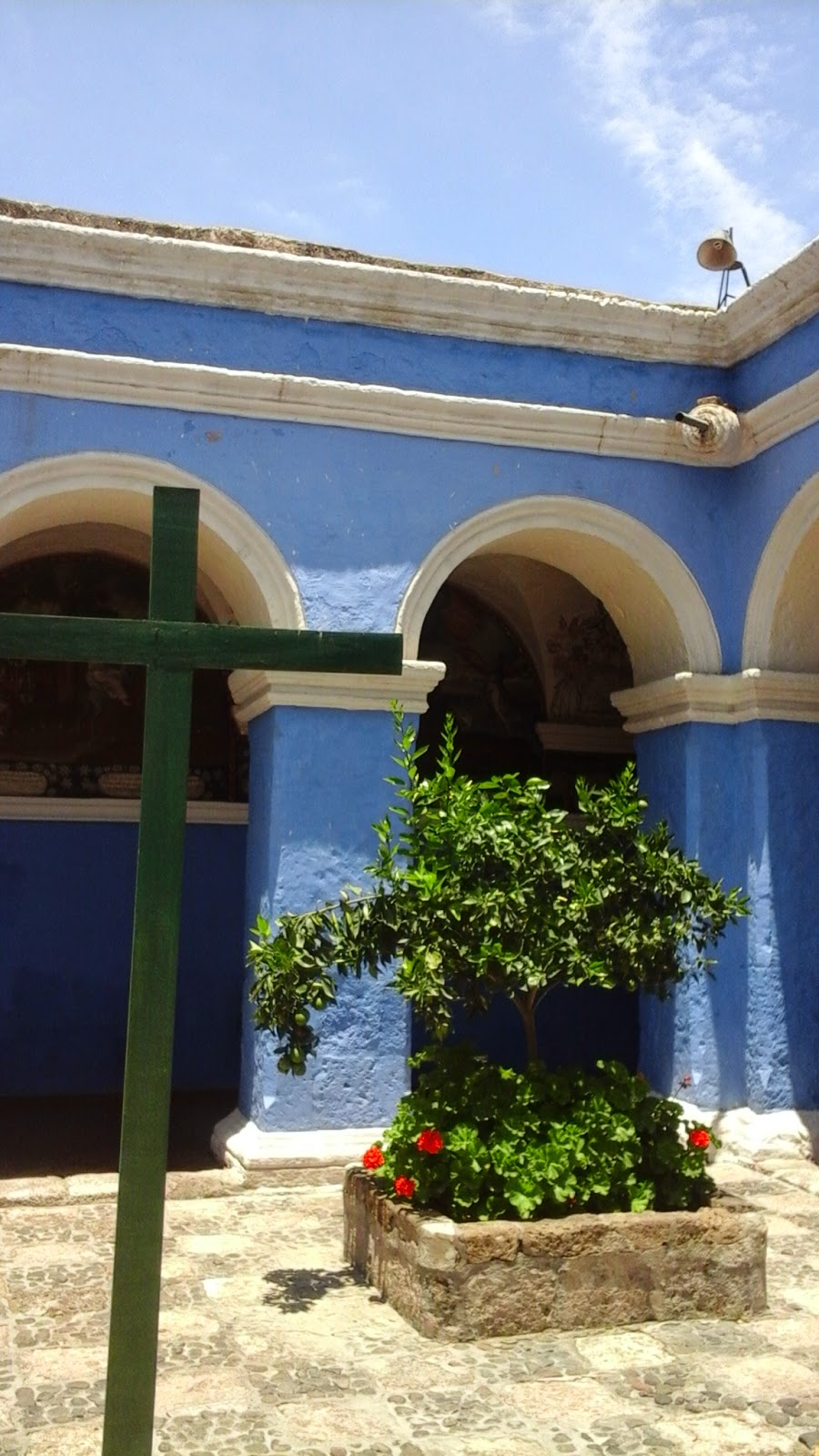
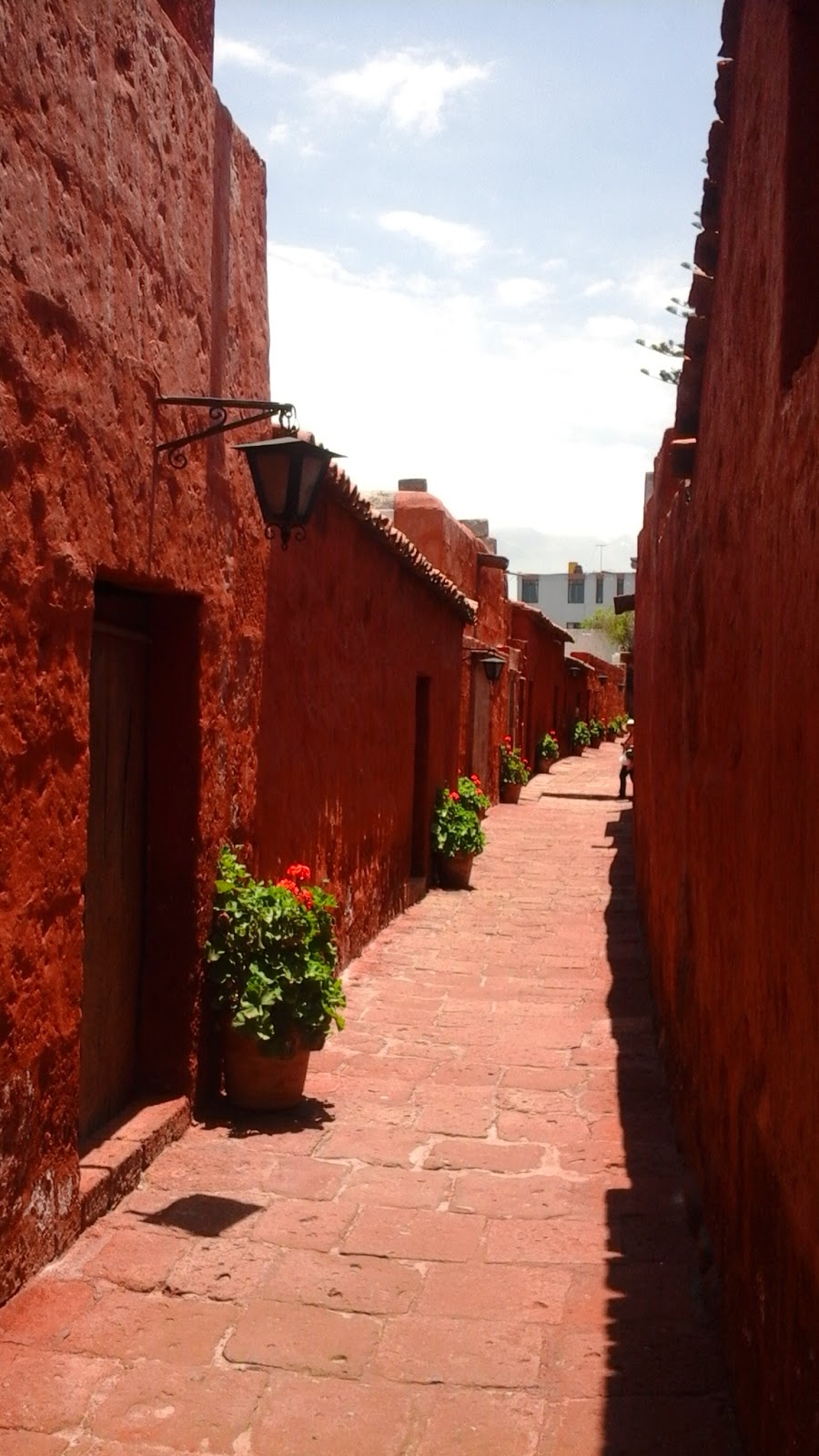
The city tour was interesting and included the Santa Catalina Monastery, across from our hotel. A beautiful place where some nuns are still cloistered. It was interesting to see the rooms where a 'rookie' (we taught our guide José that one) nun would stay in her first year, then move on to a larger room where maybe she would have a number of servants and then possibly to her place as Mother Superior. Some real history here and quite pleasant.

Errrrrtt.....rewind...when in Lima we also visited a cloister but couldn't take photos there, and the huge baroque-style Church of San Francisco from the late 1600s. We visited the catacombs, which were actually part of Lima's original cemeteries. Tour guides say an estimated 75,000 bodies are buried under San Francisco alone, and the catacomb tour is not for the squeamish or the claustrophobic.

Worshippers paid money to the church to have the privilege of burying a family member there and to have peace of mind knowing that their loved on was laid to rest in a serene place. The coffin would go directly down under the church into a hole in the floor at the funeral's end, never to be seen again by the family. What they did not know, is that bodies were buried, stacked on top of another, exhumed, bones tossed around, and remains upon remains jammed in until the government finally put a stop to it. The abhorrent manner in which he church carried this out is evident in the bins of bones, not complete bodies but separated into femurs, heads etc. The were 'reorganized' for public viewing in more recent years. Imagine. There's also a deep silo filled with mostly femurs and in another section, a few small coffins believed to be those of children of clergymen or prominent people.

In Lima still, we visited the Plaza San Martín. Funny story here which reinforces the use of proper communication. A Spaniard was comissioned to create a statue in San Martín's honour with a female guardian angel added with llamas on her head - so he added what he thought was requested, the animal llama. Well, turns out the word for flames is also llamas. That must have been embarrassing at the unveiling! It remains today. Stock photos.

Back to the program...

We caught up on some emails and wandered into town to eat and found a vibrant city, even some sort of parade or political procession complete with dancers in local folkloric garb. Early to bed, early to rise!

Started popping high altitude meds today and Coca tea is everywhere!

Thursday, 19 February 2015

By Air, Land and Sea!

February 15 - 18, 2015

A couple of days of mucho actione heading south in Peru. After spending the night in the coastal town of Paracas, we ventured to the Ballestas Islands by high-speed boat to check out the Peruvian version of their mini-Galapogos. These rocky outcroppings in the Pacific are home to thousands of sea lions, millions of birds and plenty of fish (to sustain the birds and seals, not to mention the fishing fleet). The area is a stark contrast to the changing economics of Peru, the old fishing activities are being supplanted by tourism judging by the boats hauling people instead of fish. Even more obvious are new developments such as a massive liquefied natural gas port to export energy being pumped from the Amazonia interior. As well, a couple of major steel plants operate in the area while the natural ecological zone is under federal protection as a national park.

One thing about gulls, boobies, terns, penguins and seals, they don't defecate from the nest. Glad to leave the stench of guano behind. Can't believe people shovel the stuff for a living.

We did make a a major discovery along the way and settled an age-old debate, (at least in our minds), which has raged between Chile and Peru . Namely, which country owns Pisco and can claim the bragging rights to the best libation on the continent. A pit stop at a Peruvian winery and pisco distillery in Ica proved to us that Peru can rightfully wear the Pisco crown - the proof is in the proof!

A couple of hours drive inland brought us upon massive sand dunes with a small town around an oasis smack in the middle. The only activity in this windswept region is riding dune buggies over the many dunes (more like sand mountains). As a sideline, visitors can ride surfboards down the steep inclines. We declined, since the sand was already burning our feet in our sandals, we could only imagine the increased sensation when the inevitable tumble occurred. We needed showers badly that day after being sandblasted but it was so fun!

Besides, it was time to continue through the desert to Nazca, the site of the world's most extensive geoglyphs preserved in the flatlands of the Atacama desert. While there are a couple of observation towers beside the highway where a few of the lesser designs can be viewed, the only real way to appreciate their impressive extent is to fly over the landscape in a small plane at a couple of hundred metres with the pilot adeptly circling the various figures while shouting out the description: "monkey, hummingbird, condor, dog, flamingo, whale, spider, parrot and ET. I kid you not, there's what they refer to as an astronaut figure, or ET carved into the ground between 400 and 600 AD. Someone had a sense of humour, either that or a rogue band of juvenile delinquents of the day! It's quite incredible to think that an entire civilization burned itself out making lines in the desert.

The theories abound as to purpose of the Nazca lines in the middle of one of the driest unforgiving spaces in the world (why would anyone trudge around in the desert without water moving rocks and stones and sweeping dirt). What is known is that climate change 2,000 years ago affected the lives of the Nazca people and many years of drought limited their ability to survive. Whether the creation of these elaborate symbols was to appease the gods or had some other purpose is unclear, but one could conclude that the energy and resources committed to this endeavour contributed to their decline. They would have been better off directing this energy to building more irrigation channels or digging deeper wells. Instead, like many civilizations and societies in decline, they expended their resources in futile pursuits instead of addressing their real issues.

Sounds so familiar... will we ever learn?

After our flight we hopped into the van with our new friend Raúl for the long dusty trek to Arequipa, some 9 hours away. It's been a hell of a ride...

Of note, we stopped at a nice buffet restaurant in the middle of nowhere for lunch and I snapped a pic of some sweet Guinea  pigs, soon to be someone's dinner. Cuy, in Español, is a delicacy and we are in cuy country. Rainer plans to order it in Cusco....usually people raise their own in their homes, for consumption.

Plan ahead. If there's a fire, start digging out the hydrant. Just one example of how things work - or don't, as it were.
We were astounded to learn that a) rice is grown in Peru and b) it grows in the middle of the desert. You can see the lush green fields at the foot of the mountains. They bale the stalks for cattle.